
Sometimes you need an art lesson now.
Not after a supply run. Not after printing twelve worksheets. Not after building a full slide deck, hunting for glue sticks, and emotionally negotiating with a glitter container.
You need something creative, flexible, and easy to explain in under two minutes.
That is where no-prep art lessons shine.
A good no-prep art activity gives students a clear starting point, leaves room for imagination, and does not require complicated materials. A pencil, paper, a sketchbook, and one weird idea can be enough to get the whole room drawing.

What Makes a Good No-Prep Art Lesson?
A no-prep art lesson does not mean “no structure.” It means the structure is simple enough that you can start quickly.
The best no-prep art activities usually have four things:
A clear starting point
Students should know what to draw without staring at the page for ten silent minutes.
Simple materials
Pencils, paper, sketchbooks, markers, or whatever is already in the room.
Room for choice
The prompt should guide the activity without making every drawing look the same.
A low-pressure goal
The point is creative momentum, not a museum-ready masterpiece.
That is why drawing prompts work so well in classrooms. They create just enough direction to begin, then leave students free to make their own strange decisions.
A good prompt does not finish the idea. It opens the door.
Lesson Idea 1: The 10-Minute Prompt Draw
This is the easiest no-prep art lesson to run when you have a short class window, an early finisher group, or a few minutes to fill before the bell.
Give students one drawing prompt and set a timer for 10 minutes. Their job is not to make it perfect. Their job is to make it exist.
How to run it
- Choose one prompt for the whole class.
- Set a timer for 10 minutes.
- Students draw silently or with quiet music.
- When the timer ends, students add one final detail.
- Invite volunteers to share the weirdest choice they made.
This works especially well as a warm-up because it gets students drawing before they have time to overthink.

Need fast classroom prompts?
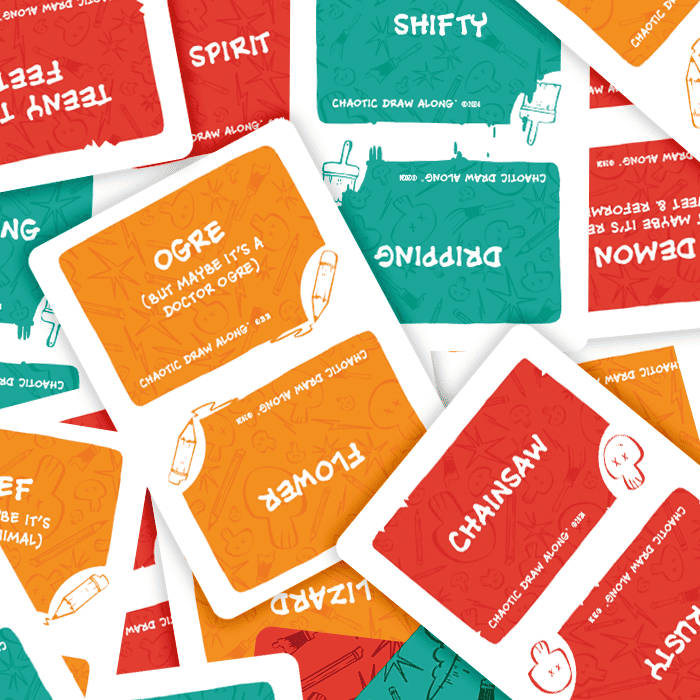
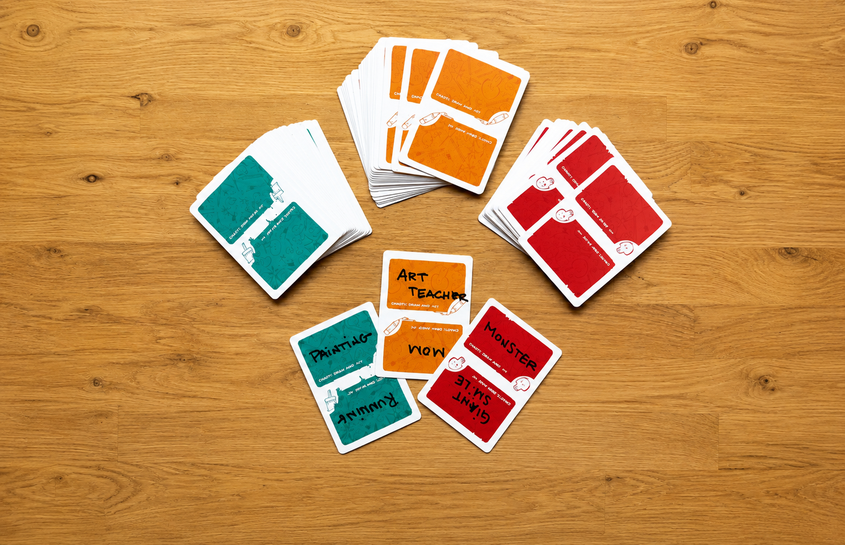
Pull a Subject, Descriptor, and Chaos card from the Chaotic Draw Along Prompt Deck and turn a blank page into a quick creative challenge.
Shop the Prompt DeckLesson Idea 2: Everyone Gets the Same Prompt
One of the best parts of prompt-based drawing is seeing how differently students interpret the same idea.
Give the whole class one prompt, such as:
-
A fancy frog late for an important meeting.
-
A slice of pizza trying to hide a secret.
-
A tiny dragon who is scared of bubbles.
-
A robot learning how to be dramatic.
-
A raccoon running a very serious business.
-
A wizard who accidentally turned invisible.
After the drawing time ends, let students compare results. The learning moment is simple: the same prompt can lead to many different creative choices.
This makes a great discussion about interpretation, style, storytelling, composition, and visual details.
Lesson Idea 3: The Three-Card Chaos Challenge
This one is ideal when students need more direction than a single word, but you still want the activity to feel playful.
Use a three-part formula:
Subject + Descriptor + Chaos
Three small pieces create one unexpected drawing challenge.
What the student draws
What it is like or doing
The strange twist
A grumpy octopus baking in zero gravity.
Students can pull cards individually, in pairs, or as a whole class. For younger students, choose the cards yourself. For older students, let them draw blindly and work with whatever strange combination appears.
The chaos is the point.
Lesson Idea 4: Draw, Swap, Continue
This classroom drawing game turns one sketch into a group collaboration.
Each student starts with a prompt and draws for five minutes. Then they pass the paper to someone else, who adds to the drawing for another five minutes.
How to run it
- Each student starts a drawing from the same prompt or different prompts.
- Set a timer for five minutes.
- When the timer ends, students pass their drawing to the right.
- The next student adds a new detail, background, object, or problem.
- Repeat two or three times, then return the drawing to the original artist.
This is a great activity for loosening up perfectionist students because nobody has total control of the final drawing. It also creates a lot of laughter, which is secretly very useful in an art room.
Collaborative drawing teaches students to respond, adapt, and let go a little.
Lesson Idea 5: Sketchbook Warm-Up Page
A Sketchbook warm-up page is perfect for ongoing classroom routines.
Instead of making every activity a separate finished project, students can keep a running collection of warm-ups, prompts, thumbnail sketches, experiments, and visual ideas.
Try this weekly format:
- Monday: one quick prompt drawing
- Tuesday: draw the same idea in a new style
- Wednesday: add a background or setting
- Thursday: redesign the character, object, or creature
- Friday: choose one sketch to improve
By the end of the week, students have a full page of creative experiments instead of one high-pressure blank page.

Turn warm-ups into a sketchbook habit
CDA sketchbooks give students a place to collect quick drawings, strange experiments, prompt challenges, and the tiny ideas that turn into bigger projects later.
Shop SketchbooksLesson Idea 6: Mystery Prompt Stations
This is a simple way to add movement to a classroom drawing activity.
Set up different prompt stations around the room. Each station gives students a different drawing challenge. Students rotate every five to eight minutes and add a new idea to their page.
Creature
Draw the main character or creature.
Mood
Add an emotion, expression, or attitude.
Setting
Put the drawing somewhere unexpected.
Chaos
Add the twist that makes the drawing weird.
By the end, each student has a layered drawing built through small decisions instead of one intimidating assignment.
Tips for Different Ages
The same activity can work across different age groups if you adjust the rules.
Younger students
Use shorter timers, simpler prompts, and lots of visual examples. Let the drawings be silly and expressive.
Older students
Add constraints such as composition, shading, character design, setting, or storytelling.
Mixed groups
Use the same prompt, but offer optional challenge layers for students who want more complexity.
Substitute days
Keep the instructions short, the materials simple, and the final goal flexible enough for any class period.
Quick No-Prep Art Lesson Checklist
Before you start, keep the activity simple:
- One clear prompt
- One simple material setup
- One timer or time limit
- One optional challenge for early finishers
- One quick share, reflection, or gallery walk
That is enough. Not every lesson needs to be complicated to be useful.
Final Thought: Fast Can Still Be Creative
No-prep art lessons are not “lesser” lessons. They are often the activities that help students relax, take creative risks, and actually start making things.
A strange prompt can break the silence of a blank page. A timer can make the task feel possible. A sketchbook can turn one quick activity into a creative habit.
You do not always need a perfect plan.
Sometimes you just need a pencil, a page, and a frog who is late for a very important meeting.
Ready for a no-prep creative activity?
Grab the Chaotic Draw Along Prompt Card Deck, pull three cards, and turn your next classroom drawing warm-up into instant creative chaos.

Leave a comment
All comments are moderated before being published.
This site is protected by hCaptcha and the hCaptcha Privacy Policy and Terms of Service apply.