
You can draw a person.
You can draw a monster.
You can draw a pirate, robot, wizard, ghost, exhausted office worker, suspicious frog, or knight who definitely should not be trusted with a sword.
But designing a character that actually feels like a character is a different challenge.
That is where character drawing prompts become useful.
Instead of starting with the enormous question of “What should I draw?”, a good prompt gives you one small decision to react to. An emotion. A job. A strange object. A personality trait. A ridiculous situation.
Suddenly, you are not trying to invent everything at once.
You are figuring out what an embarrassed wizard looks like when he loses his wand.

Why Use Character Drawing Prompts?
Character design can become surprisingly complicated.
You start thinking about anatomy, clothing, poses, facial expressions, silhouette, backstory, color, personality and whether this person really needs seventeen belts.
Sometimes they do.
But when you are warming up, the goal is not to solve an entire character.
The goal is to explore.
Character drawing prompts give you a constraint, and constraints can make drawing easier. Instead of searching through every possible idea, your brain has something specific to respond to.
You can use the exercises below as five-minute drawing warm-ups, longer sketchbook studies, character design practice or starting points for a finished illustration.
12 Character Drawing Prompts to Try
1. Give Them an Emotion
Start with a simple character, then exaggerate one emotion: embarrassed, furious, suspicious, delighted, nervous or completely exhausted.
2. Give Them a Job
Design a character around an occupation. Try a ghost dentist, nervous knight, dragon librarian or mushroom detective.
3. Give Them the Wrong Object
Put something completely inappropriate in their hands. A wizard with a leaf blower. A pirate with a tiny umbrella. A monster carrying groceries.
4. Give Them Two Opposite Traits
Combine ideas that should not fit together: terrifying but polite, heroic but lazy, elegant but chaotic, tiny but intimidating.
5. Design the Silhouette First
Forget details. Draw a character using only a strong outer shape, then work backward and decide who could possibly have that silhouette.
6. Change Their Proportions
Make one feature unusually large, tiny, long, wide or narrow. Push the proportions far enough that they begin suggesting personality.
7. Catch Them Mid-Action
Do not draw the character standing politely. Make them running, falling, sneaking, climbing, arguing, dancing or desperately trying to catch something.
8. Give Them a Problem
Characters become more interesting when something is happening. Their sandwich is escaping. Their spell went wrong. Their pet is enormous.
9. Design Around One Prop
Choose an object first — helmet, backpack, enormous pencil, mysterious key, coffee mug — and let it influence the rest of the character.
10. Change the Age
Draw the same character as a child, teenager, adult and extremely old version of themselves. Notice what changes and what stays recognizable.
11. Put Them Somewhere Unexpected
Move the character into an environment that creates a story: underwater, on the moon, inside a refrigerator, at a wedding or waiting at the DMV.
12. Combine Three Random Ideas
Pick a subject, a trait and an action. Do not negotiate with the result. Your job is simply to figure out how that character could exist.
1. Start With Emotion Instead of Appearance
A common character-design mistake is starting with appearance alone.
Hair. Clothes. Armor. Accessories. Cool boots.
Those things matter, but personality usually makes the drawing more memorable.
So before deciding what the character wears, decide how they feel.
Try drawing the same basic character as:
- nervous
- furious
- embarrassed
- overconfident
- confused
- bored
- secretly delighted
Do not only change the mouth.
Change the shoulders. The spine. The eyebrows. The hands. The distance between the feet. The angle of the head.
A nervous character might shrink inward. An overconfident character might occupy as much space as physically possible.
This makes expression practice a full-body drawing exercise instead of just a collection of faces.

2. Combine a Character With an Unexpected Job
Jobs are excellent character design prompts because they immediately create questions.
What does this person carry?
What clothing do they need?
What environment do they work in?
How good are they at their job?
And most importantly: what happens when the character and the job make absolutely no sense together?
Try these character prompts:
- A vampire dentist
- A dragon librarian
- A nervous wizard accountant
- A skeleton lifeguard
- A frog detective
- A ghost baker
- A pirate kindergarten teacher
- A monster florist
You already have enough information to start making visual decisions, but you still have complete freedom over the result.
3. Use Random Drawing Prompts to Break Predictable Ideas
We tend to repeat ourselves without realizing it.
The same faces.
The same heroic poses.
The same hairstyles.
The same mysterious person wearing a hood because apparently everybody in fantasy owns one.
Random drawing prompts interrupt that habit.
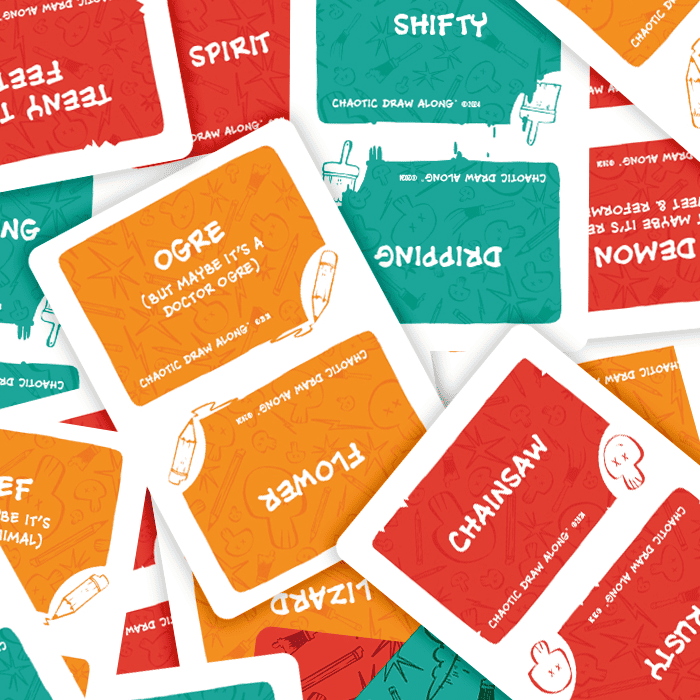
The Chaotic Draw Along Prompt Card Deck lets you combine different ideas instead of deciding everything yourself. That can force you toward combinations you probably would not have deliberately invented.

Make the prompt decide
Pull a strange combination, stop negotiating with the blank page, and figure out what kind of character could possibly come from it.
4. Draw the Character Doing Something
A neutral standing pose is useful when you are designing clothing or proportions.
It is less useful when you want to discover personality.
Action forces decisions.
If your character is running, are they graceful or completely uncoordinated?
If they are sneaking, are they actually good at it?
If they are carrying something heavy, do they struggle dramatically or pretend everything is fine?
Try pairing a character with one action:
Running
What does the pose tell you about speed, confidence and coordination?
Hiding
What does this character think counts as an excellent hiding place?
Dancing
Are they incredible, terrible or performing with unjustified confidence?
Carrying
Give them something much larger, stranger or more inconvenient than expected.
5. Use Props to Suggest a Story
You do not need to write an entire backstory before drawing a character.
Sometimes one object is enough.
Give the character a broken trophy.
A suspicious suitcase.
A tiny crown.
An enormous spoon.
A very old key.
Then ask:
Why do they have it?
Do they want it?
Did they steal it?
Are they protecting it?
Do they have absolutely no idea what it does?
Those questions begin creating a story while you draw.
6. Practice With Opposites
One of the easiest ways to make a character less predictable is to combine two traits that seem incompatible.
Try:
- A terrifying character who is extremely polite
- A tiny character with enormous confidence
- A powerful wizard who panics easily
- A villain who desperately wants everyone to like them
- A giant monster who hates confrontation
- A heroic knight who would rather be napping
- A glamorous character who is permanently covered in mud
You now have tension built directly into the character.
That tension affects pose, expression, clothing and storytelling.

7. Turn Character Prompts Into a Five-Minute Drawing Warm-Up
You do not need to finish every character.
In fact, you probably should not.
Quick character warm-ups are useful because they remove the expectation that every sketch deserves to become finished art.
Set a timer for five minutes.
Choose one prompt.
Draw until the timer ends.
Then stop.
A simple 15-minute character warm-up
- 5 minutes: Draw the character's silhouette and basic pose.
- 5 minutes: Add expression, clothing and one important prop.
- 5 minutes: Push one feature much further than feels reasonable.
You can stop there or continue developing whichever sketch has the most potential.
8. Keep a Character Prompt Page in Your Sketchbook
A sketchbook does not need to contain one polished illustration per page.
Use an entire spread for character experiments.
Draw four tiny silhouettes.
Try six facial expressions.
Redesign the same costume three times.
Draw the character angry, sleepy, terrified and suspicious.
Keep all the failures too.
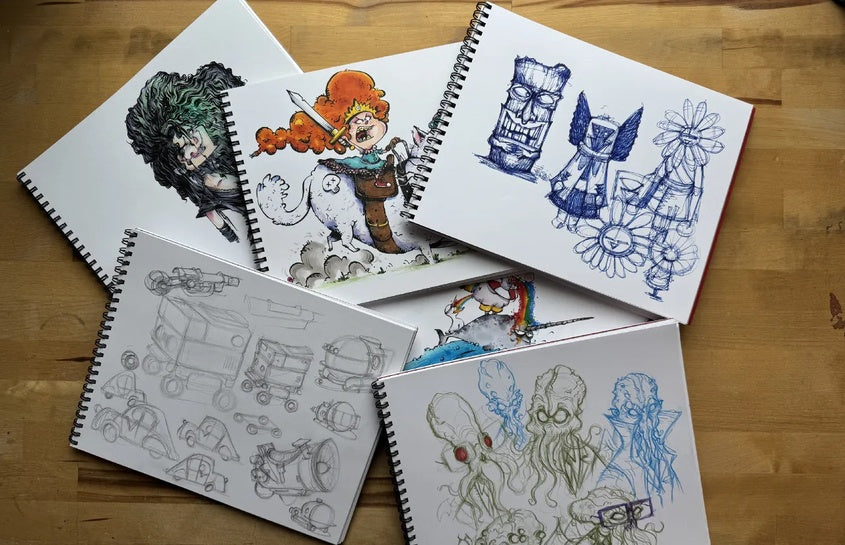
The Chaotic Draw Along Sketchbook works well for this kind of low-pressure character exploration because the goal is not perfection. It is accumulating ideas.

Give the weird characters somewhere to live
Use a sketchbook for expressions, silhouettes, costumes, unfinished characters and the ideas that are too strange to throw away.
9. Redraw the Same Character From a New Prompt
This is one of the best exercises once you find a character you actually like.
Do not immediately invent another character.
Keep the same one and change the situation.
For example, draw your character:
- at work
- running late
- trying to impress someone
- completely exhausted
- wearing formal clothes
- caught doing something embarrassing
- ten years younger
- twenty years older
- holding something they absolutely should not have
Every new prompt forces you to answer another question about the character.
That is how a sketch begins turning into someone recognizable.

10. Do Not Try to Make Every Prompt Logical
Some prompts will immediately make sense.
Others will sound ridiculous.
Those are often better.
If you get something like:
“Embarrassed + Dragon + Baking”
do not replace it with something sensible.
Maybe the dragon burned the cake.
Maybe the dragon is the oven.
Maybe everyone expected dragons to be naturally excellent bakers and this one is dealing with tremendous cultural pressure.
You only need enough logic to make yourself want to draw the scene.
Character Drawing Prompts You Can Use Right Now
If you want a few quick character ideas before leaving this page, try these:
The Nervous Dragon
A nervous dragon attempting something that requires extremely steady hands.
The Retired Villain
A former supervillain trying very hard to enjoy a quiet hobby.
The Tiny Knight
A miniature knight facing an enemy approximately fifty times larger.
The Haunted Artist
An artist whose drawings keep doing things when nobody is watching.
The Exhausted Wizard
A wizard who has clearly cast one spell too many today.
The Suspicious Frog
A frog detective who is absolutely certain something strange is happening.
The Fancy Monster
A terrifying creature dressed for the most important dinner party of its life.
The Overconfident Ghost
A ghost attempting something ghosts are famously terrible at.
The Point Is Not to Find the Perfect Character Prompt
The prompt only has one job:
Get you drawing.
You can change the idea halfway through.
You can ignore part of it.
You can discover a completely different character while trying to draw the original one.
That is not failing the prompt.
That is exactly what creative warm-ups are supposed to do.
They create movement.
One strange character leads to another sketch. That sketch creates a costume idea. The costume suggests a story. The story creates another character.
And suddenly you are no longer staring at a blank page.
Need a character to start with?
Let the cards make the first weird decision. Pull a prompt, open the sketchbook and see who shows up.

Leave a comment
All comments are moderated before being published.
This site is protected by hCaptcha and the hCaptcha Privacy Policy and Terms of Service apply.