
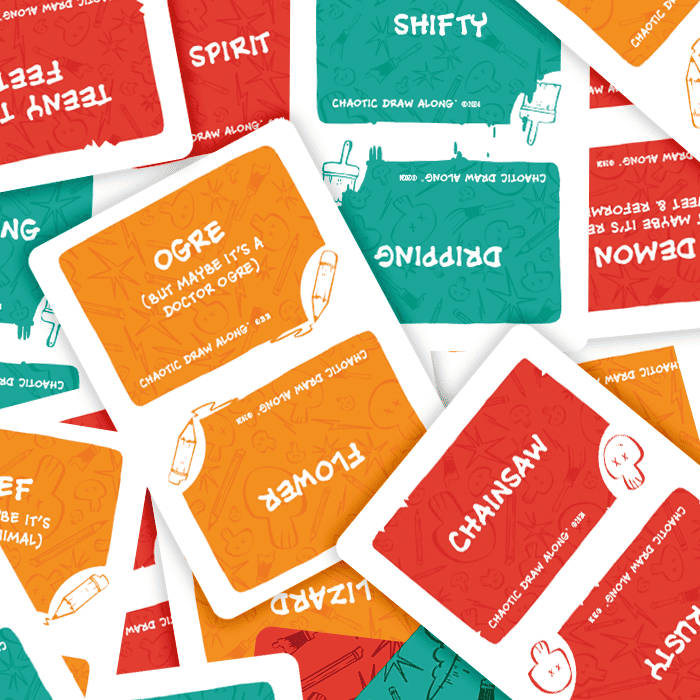

What Are Drawing Prompt Cards?
Drawing prompt cards are small cards that give you ideas for what to draw when your brain has decided to become a blank, dusty hallway.
Instead of sitting in front of a sketchbook thinking, “I should draw something,” a prompt card gives you a starting point. It might tell you to draw a character, an object, an animal, a weird mood, a silly action, or a strange situation. Sometimes the idea is simple. Sometimes it is deeply unnecessary in the best possible way.
That is the point.
Drawing prompt cards are not there to make you create perfect art. They are there to get your pencil moving.
They are useful for artists, students, teachers, families, casual doodlers, sketchbook people, and anyone who wants to draw more but does not always know where to start.

Need a starting point?
Pull a Subject, Descriptor, and Chaos card from the Chaotic Draw Along Prompt Deck and let the tiny cardboard gremlins decide what you’re drawing today.
Pull Your First PromptWhy Drawing Prompts Help with Art Block

Art block often starts before the drawing even begins.
You open your sketchbook. You want to make something. Then your brain suddenly becomes very serious and unhelpful.
“What should I draw?”
“What if it looks bad?”
“What if the idea is boring?”
“What if I ruin the page?”
Drawing prompts help because they remove the first decision. You do not have to invent the idea from nothing. You just respond to the prompt.
That small shift can make drawing feel lighter.
Instead of trying to create the perfect concept, you can ask:
- How would I draw this?
- What is the funniest version of this idea?
- What tiny detail would make this weirder?
- What happens if I only spend 10 minutes on it?
- What happens if I stop caring whether it is “good”?
That is where the fun usually starts.
How Drawing Prompt Cards Work
Most drawing prompt cards work by giving you one idea at a time. You pull a card, read the prompt, and draw whatever it suggests.
Chaotic Draw Along works a little differently.
Instead of giving you one fixed idea, the deck uses a three-card system. You pull different types of cards and combine them into one drawing challenge.
How the cards work
Pull one card from each category, combine them, and let the chaos build your next drawing idea.

What you draw.

What it looks like, feels like, or is doing.

The weird extra twist.
A dancing dragon ready for battle.
For example, you might get:
- A subject: what you are drawing
- A descriptor: what it looks like, feels like, or is doing
- A chaos card: the strange extra detail that makes everything slightly more ridiculous
That means you are not just drawing “a fox.”
You might be drawing a sleepy fox wearing armor, a suspicious taco on a skateboard, or a dramatic potato having the worst day of its life.
The more unexpected the combination, the less pressure there is to make it perfect. A weird prompt gives you permission to make weird art.

5 Easy Ways to Use Drawing Prompt Cards
 10-minute warm-up
1. Use Them as a 10-Minute Warm-Up
Before starting a bigger piece, pull a prompt and set a timer for 10 minutes.
The goal is not to make a finished drawing. The goal is to loosen up. Think of it like stretching before exercise, except the exercise is making a confused wizard ride a tiny bicycle.
Try this:
- Pull your prompt cards.
- Set a timer for 10 minutes.
- Draw without erasing too much.
- Stop when the timer ends.
- Move on before your inner critic starts giving a speech.
This is great for daily sketching, creative warm-ups, and getting back into drawing after a break.
 beat art block
2. Use Them When You Have Art Block
When you feel stuck, do not ask yourself to create a masterpiece.
Ask yourself to draw one strange thing.
Pull a prompt and treat it like a tiny assignment. You are not responsible for making the idea logical. The cards made the decision. You are simply the person documenting the chaos.
A good art block prompt should feel specific enough to start, but open enough to interpret in your own way.
For example:
- A nervous dragon at a birthday party
- A melted robot in a garden
- A tiny pirate with a very large sandwich
- A haunted pencil case
- A grumpy mushroom taking a vacation
None of these ideas need to be perfect. They just need to exist.
That is already a win.
 fill your sketchbook
3. Use Them in Your Sketchbook
Prompt cards are especially helpful if you want to keep a sketchbook but never know what to put in it.
You can use one page per prompt, or divide a page into smaller boxes and fill it with quick prompt sketches. This makes your sketchbook feel less precious and more playful.
Try a weekly sketchbook routine:
- Monday: one quick prompt
- Wednesday: one prompt with color
- Friday: one prompt with extra detail
- Sunday: redraw your favorite prompt from the week
Over time, your sketchbook becomes less of a scary blank object and more of a record of strange little experiments.
 classroom friendly
4. Use Them for Classroom Art Warm-Ups
Drawing prompt cards can be a great classroom tool because they give students a clear starting point without making every student draw the exact same thing.
Teachers can use prompts as:
- Bell work at the start of class
- Early finisher activities
- Sketchbook assignments
- Creative thinking exercises
- Group drawing challenges
- Character design practice
- Imagination warm-ups
The best classroom prompts are simple enough for beginners but flexible enough for advanced students to add their own ideas.
For example, “draw a creature with an unusual job” can become a quick doodle for one student and a full character design for another.
Prompt cards also help reduce the pressure of “I don’t know what to draw,” which is one of the fastest ways for students to get stuck before they begin.
 family game night
5. Use Them as a Family or Party Drawing Game
Drawing prompts do not have to be serious.
In fact, they may be better when nobody is being serious at all.
For a family drawing night or party game, give everyone the same prompt and set a timer. When time is up, reveal the drawings.
The fun is seeing how differently everyone interprets the same idea.
One person draws a heroic raccoon. Another draws a raccoon having an emotional crisis. Someone else draws something that is technically not a raccoon but has “raccoon energy.”
All valid.
You can also make it more chaotic:
- Everyone pulls one card and passes it to the left.
- One person draws the subject, then another adds the chaos detail.
- Everyone has 60 seconds to start, then swaps sketchbooks.
- The group votes on categories like “most dramatic,” “most cursed,” or “most likely to need snacks.”
Again, the goal is not perfect art. The goal is shared creative nonsense.

Make family night weirder in the best possible way
The Family Night Bundle includes the Prompt Deck, Doodle Books, pencils, erasers, and a tote, so everyone can jump into the same chaotic drawing challenge.
Shop the Family Night BundleDrawing Prompt Ideas to Try Right Now
Here are a few quick prompts you can try today:
- Draw a sleepy monster who just woke up late.
- Draw a sandwich with a secret identity.
- Draw a tiny wizard trying to fix a huge problem.
- Draw an animal wearing something completely unnecessary.
- Draw a robot who has discovered emotions.
- Draw a haunted object from your kitchen.
- Draw a dragon who is afraid of something very small.
- Draw a superhero with a deeply inconvenient power.
- Draw a mushroom going on vacation.
- Draw a raccoon who absolutely did not do it.

Need somewhere to put the weird stuff?
Pair your prompts with a CDA sketchbook built for warm-ups, doodles, daily drawing, and strange little creative experiments.
Shop SketchbooksHow to Make a Prompt More Interesting
If a prompt feels too simple, add one extra twist.

Start with:
“Draw a cat.”
Then add:
- a mood: grumpy, nervous, dramatic, suspicious
- an action: dancing, hiding, floating, arguing
- a place: in a castle, at the beach, inside a vending machine
- a problem: lost its crown, forgot its spell, stole a sandwich
- a style: tiny, gigantic, melted, fancy, haunted
Now “draw a cat” becomes:
“Draw a suspicious cat hiding inside a vending machine.”
Much better. Much worse. Perfect.
How Long Should You Spend on a Drawing Prompt?
That depends on what you need.
For a warm-up, spend 5 to 10 minutes.
For a sketchbook session, spend 15 to 30 minutes.
For a finished illustration, use the prompt as a starting point and take as long as you want.
The trick is to decide before you start. A quick prompt should stay quick. Not every drawing needs to become a polished piece. Some drawings are just there to shake the dust out of your brain.
What Makes a Good Drawing Prompt?
A good drawing prompt usually has three things:
-
A clear starting point
You know what to begin drawing. -
Room for interpretation
The prompt does not control every detail. -
A little surprise
Something unexpected makes it more fun.
That surprise is important. If the prompt is too normal, it can feel like homework. If it is too strange, it can feel impossible. The best prompts live somewhere in the middle: clear enough to start, weird enough to make you curious.
Final Thought: The Blank Page Is Not the Boss of You
Drawing prompt cards are a simple tool, but they solve a very real problem.
They help you start.
And starting is often the hardest part.
Whether you are an artist trying to beat art block, a teacher planning a quick warm-up, a parent looking for a screen-free activity, or a person with a sketchbook that has been silently judging you from across the room, drawing prompts give you a way in.
Pull a card. Start messy. Make something weird.
The blank page had its chance.
Now it is your turn.

Ready to make the blank page someone else’s problem?
Grab the Chaotic Draw Along Prompt Card Deck, pull three cards, and let your next drawing idea choose itself.

Leave a comment
This site is protected by hCaptcha and the hCaptcha Privacy Policy and Terms of Service apply.