
A sketchbook does not have to be a collection of your best drawings.
It can be the place where weird ideas begin, proportions go wrong, characters change halfway through the page and experiments lead absolutely nowhere.
That is not a failed sketchbook. That is a sketchbook doing its job.
The problem starts when every blank page feels like it needs to become something polished enough to show people.
So instead of treating your sketchbook like a portfolio, try treating it like a creative playground.

Stop Treating Every Page Like a Finished Illustration
One of the fastest ways to make drawing stressful is to expect every page to become something impressive.
Instead, give the page a smaller job. Let it answer a question, test a possibility or make an idea stranger.
Change One Thing
Make the legs longer. Change the expression. Give the character a completely different silhouette.
Try Several Versions
The first sketch does not have to solve the idea. Let version two react to version one.
What If?
What if the object were enormous? What if the pose were exaggerated? What if the idea became ridiculous?
Let It Be Bad
Some drawings exist only to show you what you do not want to do next.
1. Make Pages That Are Supposed to Be Messy
Give yourself pages where neatness is not even part of the goal.
A chaotic page can contain more useful ideas than a beautiful page you were too afraid to experiment on.
2. Draw Variations Instead of Starting Over
If a drawing feels wrong, you do not always need a fresh page.
Keep the first version and let the next sketch respond to it.
Too stiff
More movement
Push it further
Change the Pose
Push the movement farther than feels necessary.
Change the Shape
Stretch, squash, simplify or exaggerate the proportions.
Add Something Weird
A strange prop can completely change the direction of the idea.
Instead of thinking “that drawing failed,” try thinking “version one showed me what to change in version two.”
3. Let Words Live Beside Drawings
Your sketchbook does not need to contain only sketches.
Words can help an unfinished drawing become something more interesting later.
4. Make the Drawing Smaller When the Page Feels Too Serious
A huge empty page can make a simple idea feel strangely important.
Instead of committing the whole page to one drawing, give yourself several tiny spaces to explore.
Try Six Instead of One
Six small attempts often feel easier than one large drawing that suddenly has to be “good.”
Explore Before You Commit
Use thumbnails for poses, characters, objects, expressions or compositions.
5. Combine Things That Normally Do Not Belong Together
A sketchbook is the perfect place for combinations that would feel too ridiculous for a serious project.
A Tired Knight
...carrying groceries after a very long quest.
A Suspicious Mushroom
No explanation needed. Figure out why it looks suspicious while drawing.
An Office Dinosaur
Laptop. Tie. Tiny coffee cup. Absolutely normal workday.
A Terrible Wizard
Powerful magic. Extremely questionable execution.
You do not have to know whether the idea is good before drawing it.
Unexpected combinations force your brain away from the same familiar solutions.

Give Your Sketchbook Something Unexpected to Work With
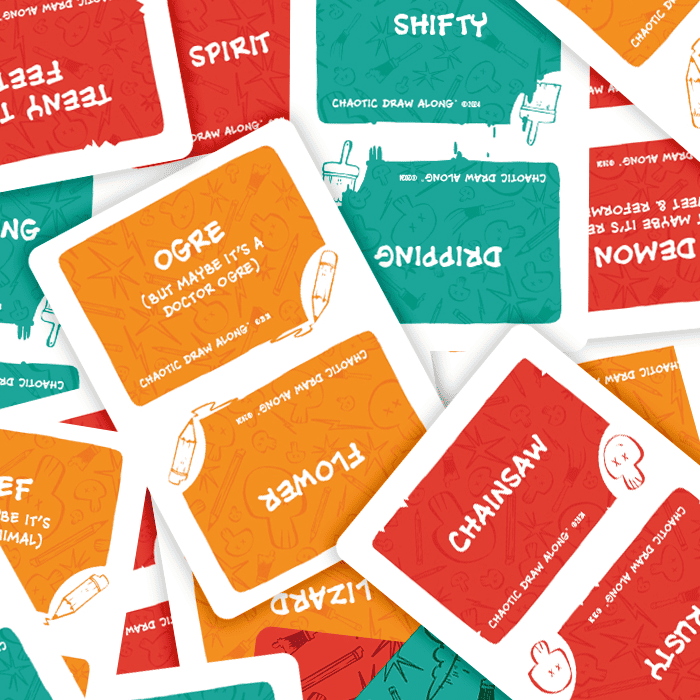
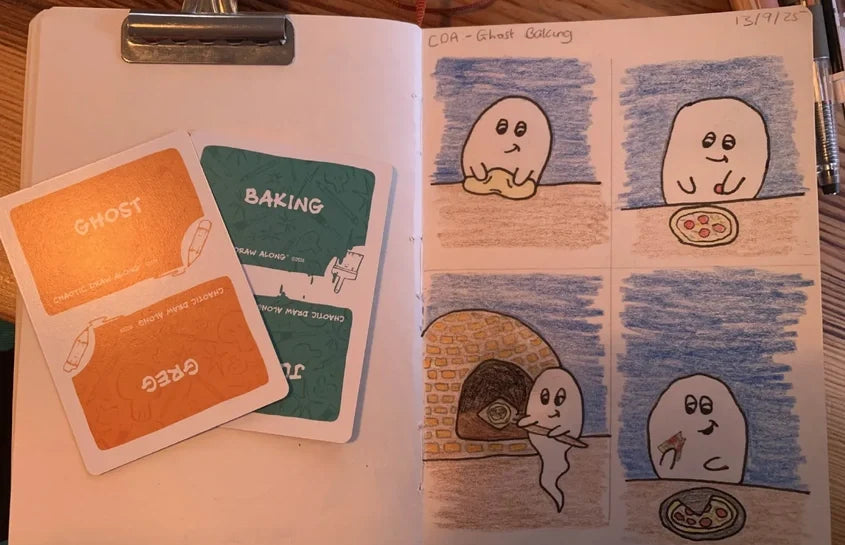
When your brain keeps returning to the same ideas, combine Chaotic Draw Along prompt cards and let the random combination decide where the page goes next.
SHOP THE PROMPT DECK6. Keep the Bad Drawing
There is a useful moment when you make a drawing you dislike and simply turn the page.
Do Not Tear It Out
Leave the evidence where it is.
Do Not Fix Everything
You are allowed to stop working on a drawing.
Turn the Page
That one did not work. Next.
Keeping imperfect drawings makes the sketchbook feel less precious over time.
And once the book stops feeling precious, you become much more willing to take creative risks inside it.
7. Revisit Old Pages
A sketchbook does not have to move only forward.
Older pages can become raw material for completely new drawings.
Try the Idea Again
Take an old character, pose or object and see how you would draw it today.
Mix Two Old Ideas
Take unrelated sketches from different pages and force them into the same drawing.
Return to an Abandoned Sketch
Sometimes an unfinished drawing only needed a little distance.
Ask What You Would Change
An old drawing can show you how your creative decisions have changed.

8. Give Yourself Pages With No Purpose
Not every drawing session needs a goal.
Sometimes the best thing you can do is make a page where nothing important is supposed to happen.
These low-pressure pages keep drawing connected to curiosity instead of performance.
And sometimes the page with no plan becomes the one that gives you the best idea.
Your Sketchbook Does Not Need a Theme
You do not need separate books for serious illustration, silly drawings, character design, prompt challenges, notes and experiments unless organizing things that way genuinely makes you happy.
A shape from one experiment might become a character later. A random note might become an illustration. A strange prompt drawing might turn into something completely unrelated.
Creativity is usually much messier than the finished artwork makes it look.
Make the Sketchbook Easy to Reach
There is also a very practical reason sketchbooks stay empty: they are stored somewhere inconvenient.
On Your Desk
Keep it close to the place where you naturally sit down to draw.
In Your Bag
Give yourself something to open when you have a few unexpected minutes.
Near Your Pencils
The fewer steps between the idea and the page, the easier it is to start.
The easier your sketchbook is to open, the less time your brain has to negotiate about whether the drawing will be good enough.

A Sketchbook Made to Get Messy
Use it for prompt drawings, strange characters, unfinished experiments, notes, doodles and whatever idea decides to show up next.
SHOP THE SKETCHBOOKThe Best Sketchbook Is Not Necessarily the Prettiest One
A full sketchbook can look impressive, but that is not the most interesting thing about it.
The real value is everything that happened while filling it: ideas you would not otherwise have found, drawings that taught you something, experiments that failed and strange little sketches that eventually turned into something better.
So when a page goes wrong, leave it.
When an idea seems ridiculous, draw it.
When something is unfinished, let it stay unfinished.
Your sketchbook does not need to prove that you are good at drawing.
It just needs to give you somewhere to keep drawing.

Leave a comment
All comments are moderated before being published.
This site is protected by hCaptcha and the hCaptcha Privacy Policy and Terms of Service apply.